
Best Oils for Caregiver Stress Inhaler Blends
# Best Oils for Caregiver Stress Inhaler Blends
Short answer: if you're caregiving through grief, fatigue, or high anxiety, keep your stress kit small. Lavender, bergamot, geranium, and cedarwood cover calming, uplifting, and grounding needs, and you can blend all of them into personal inhalers you carry in a pocket or bag. Below you'll find a starter oil list, three ready to mix inhaler recipes, guidance on choosing a blend for different hard days, and safety basics before you start.
Caregiving does not wait for a good moment. Stress shows up mid task, mid phone call, mid sentence with your own kid asking for dinner while your parent needs something too. A personal inhaler is one of the few tools that fits into that reality. No diffuser, no timer, no ritual. Just a small tube you twist open and breathe from for 20 to 30 seconds.
Which essential oils are commonly used for stress relief and mood support?
You don't need a shelf full of bottles to start. A small, well chosen set covers most caregiving moments, from the 2am wake up to the waiting room.
A wellbeing journal roundup lists lavender, bergamot, and geranium among the most commonly used oils for stress relief and mood support (source). We add cedarwood and sweet orange to round out a caregiver starter kit that handles calm, lift, and grounding.
- Lavender for winding down after a hard shift
- Bergamot for a lift that still feels calm, not jittery
- Geranium for emotional balance on heavy days, a favorite in our own oil of the month notes from caregivers who use it after loss
- Cedarwood for grounding when anxiety spikes
- Sweet orange for a quick, bright reset between tasks
A 2023 systematic review and meta analysis found that aromatherapy reduced stress in healthy adults, with several randomized studies showing measurable drops in stress scores (source). That research backs up what caregivers already tell us: a few minutes with the right scent changes how the next hour feels. It does not fix the underlying situation. It does give your nervous system a small window to reset before you go back in.
If you're not sure which oils to buy first, our products page has pre-blended starter kits built around this exact list, so you're not guessing at ratios or ordering five bottles you'll barely use.
What are 3 easy inhaler blends for calming, uplifting, and grounding?
Personal inhalers are built for exactly this. You breathe in for 20 to 30 seconds, cap it, and go back to what you were doing. Essential Three points to inhalers and sprays specifically because they fit into busy caregiving environments better than diffusers or baths do (source). You cannot step away for a 20 minute soak when someone needs you. You can step into a hallway for 30 seconds.
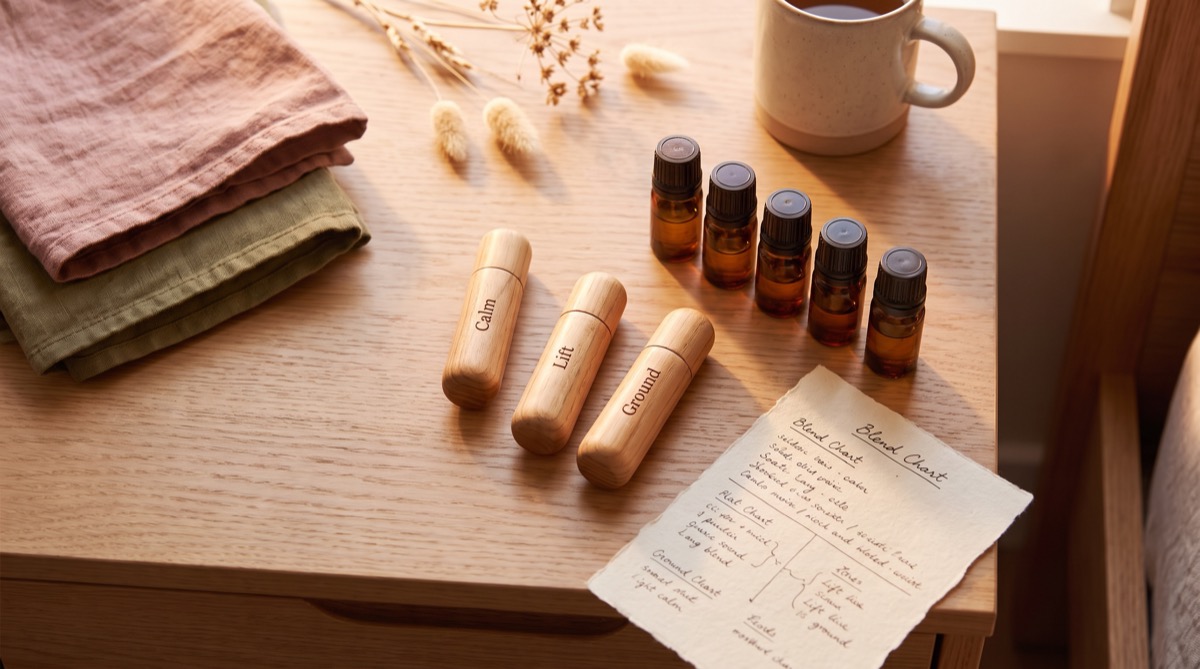
Here are three starter blends, sized for a standard inhaler wick, about 15 to 20 total drops:
| Blend | Oils | Drops | Best for |
|---|---|---|---|
| Calm | Lavender, geranium | 8 lavender, 6 geranium | Winding down, hard news, end of shift |
| Lift | Bergamot, sweet orange | 7 bergamot, 8 orange | Morning fatigue, low motivation |
| Ground | Cedarwood, lavender | 9 cedarwood, 6 lavender | Panic spikes, racing thoughts |
Drop the oils directly onto the cotton wick, let it sit for a minute, then screw the inhaler closed. Label each one so you're not guessing at 2am. Keep all three in your bag or by the bedside and choose based on how the moment actually feels, not how you think it should feel.
If you want a walkthrough with photos before you try this yourself, grab our free blending guide. It covers wick saturation, how long a blend lasts, and how to tell when it's time to remake one.
How do I choose a blend for grief days versus high anxiety days?
Grief and anxiety ask for different things, even though both feel heavy. On grief days, most caregivers tell us they want something gentle that doesn't demand energy. Reach for the Calm blend, or plain lavender alone if even a blend feels like too much decision making. Grief days are not the day to push yourself toward brightness. Let the scent sit quietly in the background while you do whatever the day requires.
High anxiety days are different. Racing thoughts, a tight chest, the sense that you cannot slow down even though you desperately want to. The Ground blend works better here because cedarwood has a heavier, earthier profile that gives your attention something to land on. Some caregivers pair Ground with a simple counted breath, four counts in through the nose while inhaling the blend, six counts out, repeated three or four times before capping the inhaler.
Fatigue without sadness or anxiety, the flat, running on empty kind of tired, is where Lift earns its place. It's not meant to override how you feel. It's meant to give you a little more room to function until you can actually rest.
Caregivers on Reddit describe burnout as more than tiredness, it's exhaustion layered with resentment and guilt, and they specifically ask for tools that fit into busy days rather than big lifestyle overhauls (https://www.reddit.com/r/CaregiverSupport/comments/1lwtb47/caregiver_burnout_is_real_what_helped_you_come). An inhaler will not resolve burnout on its own. It's one small, repeatable tool you can use several times a day without adding another task to your list.
Is it safe to use essential oil inhalers every day?
Yes, for most healthy adults, inhalers used a few times a day are considered low risk because you're not applying oil to skin and you're not diffusing into a shared room for hours. That said, a few basics matter.
Keep total drop counts within the ranges above rather than doubling up out of habit. More oil on the wick does not mean stronger relief, it usually just means the scent fades unevenly and irritates your nose faster. Store inhalers away from kids and pets, since the concentrated oil on the wick is not meant for anyone but you to breathe.
If you have asthma or another respiratory condition, check with a provider first. The American Lung Association fields regular questions about whether diffusers and oils can irritate lungs or worsen asthma symptoms, and the honest answer is that it depends on the person and the oil. Citrus oils like bergamot and sweet orange are generally gentler on sensitive airways than heavier oils, but everyone's threshold is different.
If you're pregnant, caring for an infant, or managing a chronic lung condition, it's worth a quick conversation with a professional before adding inhalers to your routine. You can book a short consult with us if you want oil specific guidance for your situation rather than generic safety copy.
Where can caregivers get support beyond essential oils?
Inhalers help with the moment. They do not replace rest, therapy, or actual time off, and no blend claims to. Many caregivers on forums ask whether therapy has actually helped anyone cope, and the honest answer from people who've tried it is that it helps most when it's realistic about time and cost, not when it demands another hour you don't have (https://www.reddit.com/r/CaregiverSupport/comments/1fp9rek/has_therapy_actually_helped_anyone_cope_with).
If you want something in between a five minute inhaler break and a full therapy commitment, we run small group sessions built around exactly this gap. Check our events page for upcoming caregiver focused sessions that combine breathing practice, blend making, and a space to talk through what the week has actually been like.
Keep your kit simple. Three inhalers, five oils, and a clear sense of which one matches which kind of hard day. That's enough to start, and it's enough to lean on when the next hard moment shows up without warning.
Want the next one in your inbox?
Join the list for a short note from Sandy most weeks, with one small ritual you can use.