
How to Use a Personal Aromatherapy Inhaler
# How to Use a Personal Aromatherapy Inhaler
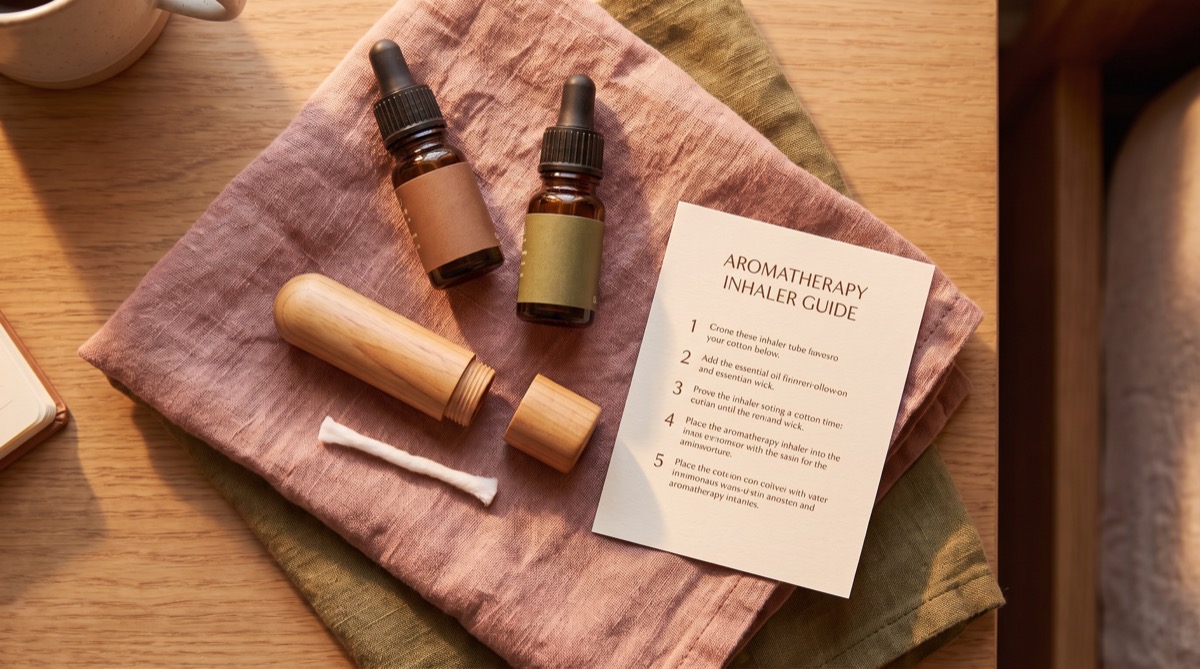
A personal aromatherapy inhaler is a small tube with a cotton wick inside, loaded with about 10 to 15 drops of essential oil. You open the cap, hold it an inch from your nose, and take two or three slow breaths. It fits in a pocket or purse, needs no water or heat, and works anywhere, including a waiting room or a hospital hallway.
What is a personal aromatherapy inhaler and why do caregivers like it?
Think of it as a scent-delivery tube you carry with you, not a diffuser you plug in. Inside is a cotton wick that holds essential oil so the aroma releases slowly every time you open the cap.
Caregivers like these for a few practical reasons:
- No mess. Nothing spills, drips, or needs cleaning.
- No noise or light, so you can use one during a nap, a quiet room, or a hospital visit without drawing attention.
- Fast. You can take two breaths and put it away in under 15 seconds.
- Portable. It rides in a coat pocket, a bag, or a car console.
One of our readers described it this way in a note to us: "This week has been good but tough and I'm tired, but I found comfort today in cooking.. the smells of the ingredients just felt like home, a hug, or like a good memory." An inhaler works on that same idea. It gives you a small, familiar scent cue you can reach for on hard days, even outside your own kitchen.
How do I use a personal inhaler step by step?
Here is the process, start to finish:
- Choose your oil or blend. Pick one scent you already know settles you, or use a blend you've tested before on a hard day.
- Load the wick. Drop the oil directly onto the cotton wick, not the plastic housing.
- Seat the wick in the tube. Push it down gently until it sits snug in the base.
- Cap it and label it. Snap the cap on and jot the blend name and date on the tube or a small sticker.
- Use it when needed. Uncap, hold about an inch from your nose, and breathe in slowly for a few breaths.
- Recap right away. This is the single biggest thing that protects how long the scent lasts.
That last step matters more than people expect. Allina Health notes that aromatherapy inhalers can act as a tool to cue deep breathing during stressful moments, including in some tobacco craving support programs. The tube itself becomes a cue: you see it, you breathe, your body starts to settle before you've even finished the second inhale.
How many drops go into an inhaler wick?
Plant Therapy notes that personal inhalers typically use about 10 to 15 drops of essential oil or blend on the cotton wick. That range works for most single oils and most blends.
A few adjustments worth knowing:
- Stronger oils (like peppermint or oregano) can sit at the lower end, closer to 8 to 10 drops.
- Softer, floral oils (like rose geranium or lavender) can handle the higher end, 12 to 15 drops, without feeling overwhelming.
- Blends of 2 to 3 oils usually split the total drop count across the oils rather than adding 10 to 15 drops of each one.
If you're not sure where to start, load the wick with 10 drops, cap it, and test it the next day. You can always add more later. It's much easier to add drops than to remove them.
How often can I use an aromatherapy inhaler?
There's no strict hourly limit for most people using a personal inhaler with common essential oils, but a simple rhythm works well for caregivers:
- Use it in short bursts of 2 to 3 slow breaths at a time.
- Space uses out rather than inhaling continuously for minutes at a stretch.
- Pair it with a specific moment, like before a hard phone call, during a waiting room stretch, or right after a difficult conversation, so it becomes a cue rather than a constant background habit.
This pairs naturally with other quick resets. If you only have two minutes between tasks, our 2-minute resets caregivers can actually do post walks through a few more options that fit around an inhaler, not instead of one.
How long does an inhaler stay fresh and when do I refill it?
Allina Health notes that the aroma in an aromatherapy inhaler can stay fresh for up to 3 months, as long as the cap stays on when you're not using it. That 3 month window is the main thing to track, not a fixed number of uses.
A simple way to manage this:
| Habit | Why it matters |
|---|---|
| Recap immediately after each use | Slows evaporation, extends the 3 month window |
| Write the fill date on the tube | Removes the guesswork later |
| Store away from direct heat or sun | Heat speeds up scent loss |
| Refill or replace at the 3 month mark | Keeps the aroma strong enough to actually help |
If you notice the scent fading well before 3 months, that's usually a sign the cap wasn't snapped on tightly, or the tube sat somewhere warm, like a car dashboard.
What are common mistakes that make an inhaler feel too strong or not strong enough?
Most inhaler problems come down to a small handful of fixable habits:
- Dropping oil on the plastic casing instead of the wick. The wick is designed to hold and slow-release the oil. Oil on plastic evaporates fast and can feel harsh up close.
- Holding the tube too close to the nose. An inch away is usually enough. Right against the nostril can feel overwhelming, especially with stronger oils.
- Leaving the cap off between uses. Even a few minutes uncapped adds up over weeks and shortens that 3 month freshness window.
- Never refreshing old wicks. A wick that's been used for months with no new drops added will feel weak no matter how you hold it.
- Skipping the drop range entirely. Guessing at "a few drops" often means 3 or 4, which is well under the 10 to 15 drop range that gives a wick real staying power.
If your inhaler still feels off after fixing these, it may just be time for a fresh wick and a new fill, which takes less than a minute.
Using an inhaler in appointments and hard moments
Caregivers often ask about using an inhaler somewhere quiet is expected, like a hospital room, a specialist's waiting area, or during a hard family conversation. A few things help here:
- Keep the tube capped and pocketed until you actually need it, so it stays low-profile.
- Take your 2 to 3 breaths with the tube close to your body rather than holding it up where others notice.
- Choose a scent ahead of time that you associate with calm, not one you're testing for the first time in a stressful setting.
One reader shared that her mind has started to treat scent almost like a mood ring, where the same oil seems to shift meaning depending on what she's feeling that day. That's worth remembering: the oil you pick for a hard appointment doesn't have to be complicated. It just has to be one you already trust.
If you want ready-made blends built for exactly these moments, our products page has a few options, and our free resource walks through blend pairings for common caregiver days. If you'd rather talk through what might fit your specific situation, you can book a time with us and we'll help you figure out a starting point.
Want the next one in your inbox?
Join the list for a short note from Sandy most weeks, with one small ritual you can use.